Documenting Gaza has Changed the World: Interview with Filmmaker Mai Masri
Victoria Brittain interviews filmmaker Mai Masri on the launch of the Gaza Cinema Academy and the powerful stories of its first cohort of young women creators.
Victoria Britain: You used the occasion of the Venice Film Festival this autumn for the international launch of The Gaza Cinema Academy. Can you tell us something about the two years of work with the team in Gaza that lies behind this initiative?
Mai Masri: Sometime after the early months of the genocide, Dr. Ezzaldeen Shalh, founder of the Gaza International Women’s Film Festival, began to call me in Beirut to discuss the idea of starting a training programme in filmmaking for young women in Gaza whose individual stories could best be told by themselves in film. Everyone in Gaza knows how the power of the image is so important. The targeted assassinations of Gaza’s brilliant, brave journalists—265 at least—underlines this. Everyone is now using their mobile phone camera, knowing this will be the only documenting of their lives, and it gives them a powerful role. The documenting of Gazans’ lives has changed the world. The impact of these images has been huge, even in the US and the UK, where it is so needed.
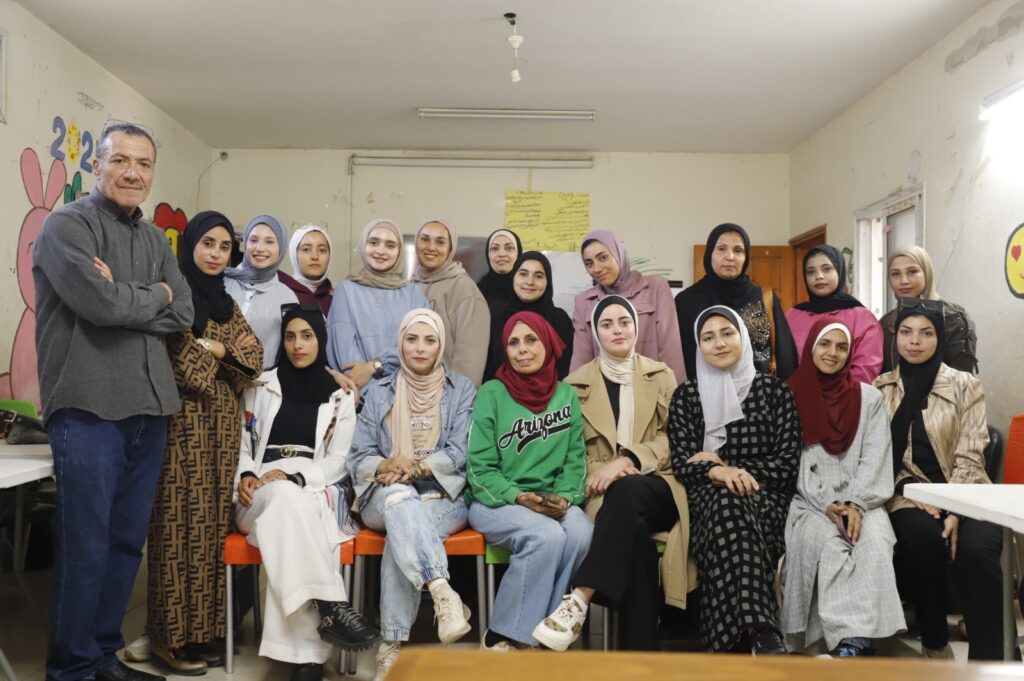
As we talked, the idea of giving women an extra tool of turning their images into film, which would empower them, fired us up as we spoke almost daily. So for the last nine months we have been organising a training programme for 25 young women, entitled Through Their Lens: Transforming Pain into Cinematic Language. Based on its success and the outpouring of creativity—which we understood as a tool of resistance and therapy—we decided to found the Gaza Cinema Academy. And on October 26, on the opening night of the Gaza Women’s International Film Festival, in the presence of the 25 young women, we had a big launch of the Gaza Cinema Academy with Dr. Ezzaldeen, and the women received a certificate to mark the first year of their training programme.
VB: Before we talk more about the Academy, can you describe how the training programme works?
MM: Dr. Ezzaldeen has a large space where the students come to attend four-hour film sessions three times a week. We have a professional team in Gaza and another one abroad who teach, both in person and by Zoom, various technical aspects of filmmaking, such as scriptwriting, camera work, sound recording, editing, animation, and visual storytelling. All of the professional trainers embraced this chance to volunteer to share their skills to empower Gaza’s women. There are 25 women in the nine-month theoretical and practical training programme. The women have already made several short films and will receive a university-accredited diploma by the end of the two-year programme.
The women make long journeys to get to the classroom, some by donkey cart. One of the women chose to make a short film about her 14-year-old neighbour and his little donkey. The boy had tragically lost all his family, except the baby donkey called Soosoo, who allows him to make a living as a taxi. Everyone has a story, or stories: the unbearable family losses, the multiple displacements, the endless fear of bombing, the hunger, the lack of water. One of the young women told me she was a “sole survivor” who lost her entire family when their home was bombed. She spent several days under the rubble and witnessed her family slowly dying around her before she was rescued. She said the training programme had given her a voice and then tools to with which to tell the world her story.
One day, during an online chat over coffee, two sisters described the devastating days of hunger they went through when they had nothing to eat except bread they made from barley and grass intended for livestock. They laughed to see my creamy-coloured little cat shoot across the room after a tiny piece of cucumber, which she ate. Many of them, too, have cats they are deeply attached to—friends to love them. Moments of laughter contrasted with the deepest tragedies which all have seen and lived and are now sharing on film.
At the beginning of the training programme, I encouraged the women to tap into their imagination as a way of unleashing their creativity and storytelling skills. It was outside their experience to process their extraordinary lives in that way. I often started with asking for them to share their dreams, and to make small personal films to show me. One sent me a video she made interviewing her sister in her tent sheltering under the bed, the only private corner she could find to work in: “I’m looking for the truth, but I’m afraid of the rats.” One of the women told me a harrowing story of survival. She had lost her home and was sheltering in a school when she witnessed all her family being executed at point blank range on their way to bury her nine-year-old nephew. Someone in the school filmed this scene secretly: the father shot, then one son shot and lying on his back with his cat sitting on his chest, the mother shot with two sons dying in her arms. The survivor could never bring herself to watch this video.
As time passed, the women began to grow in confidence and start filming stories of remarkable neighbours, such as the judo and karate medal-winning man without arms or legs, or the brother and sister, blind since birth, who have a Braille “newsroom” to broadcast information to others with visual impairment. Or the 25-year-old woman who was an athlete, then lost a leg, who now wears a 5-kilo prosthetic and plays football. Or the self-taught deaf/mute artist who draws beautiful murals of Gaza’s best-known martyrs and heroes such as such as little Hind Rajab, and the Al Jazeera journalist Anas al-Sharif, and Dr. Hussam Abu Safiya. Together, these women have developed a momentum, and they deserve to have the world see the skills they have mastered and the full picture of their Gazan society which only they can truly show. To me, they are so inspiring, and they really show how beauty and joy can be found in resilience and survival. You know, mentoring them with different kinds of supports, I have a hand, guiding, but not imposing. These films are their creations.
VB: From the diploma, is there a follow-up into an academic pathway to expand these women’s future as filmmakers?
MM: Yes, the Academy is working towards just that, a filmmaking degree accredited by Al-Quds Open University. And one of the objectives of the Academy is to support the future of these young talented women by developing and producing new Palestinian films and linking with Palestinian, Arab and international film communities. A sustainable Gaza film institution is our goal.
VB: Where is support coming from internationally?
MM: We two, Dr. Ezzaldeen and myself, have been self-funding the training programme for the last nine months. When we decided to officially launch the Gaza Cinema Academy at the Venice Film Festival in September, we immediately got support from among the best known Palestinian, Arab and other filmmakers and artists: Kaouther Ben Hania, Annemarie Jacir, Saleh Bakri, Graziella Bildesheim, Ramy Youssef, Alaa Karkouti, Hiam Abbass. There is a long way still to go with the networking behind getting backing or partnerships from universities and academic institutions inside Palestine and abroad, but so much potential support.
VB: Your own many prize-winning films are well known for your focus on memory, on children, on women and on prisoners. Has this experience confronting the genocide been a new iteration of your earlier work, which will be part of your own next film?
MM: I am making a feature documentary inspired by the women’s stories. I have learned so much from them. The film is primarily about hope, and from that, about love, courage, and creativity as tools of healing and resistance.